Wednesday, 31 October 2018

Protectionism and Donald Trump

In terms of global free trade, many observers of political events have discussed the possibility of a trade war. Recent news articles have discussed the possibility of Trump leaving the World Trade Organisation. Then we also get articles about the possibility of Russia trying to block Britain's membership of the World Trade Organisation post-Brexit. However, from my observation, many people do not understand the historical context of protectionism within the west and why Trumps America is promoting this policy.

Trump's trade policy is not unorthodox in any way. This does not mean I approve of this trade policy at all. For most of the history of the United States, the country has used a protectionist economic policy. The First President of the United States George Washington as early of 1789 used tariffs to protect the homegrown industry and to generate revenue to invest in national infrastructure. In 1789 the Young Republic was an underdeveloped backwater, with a population similar to Ireland at the time. The nation was largely agrarian and there was a lack of unity between the states. Many individual states had their own independent trade policy.

In the late 18th century and the early 19th-century Britain began a process of industrialisation. After the Napoleonic war, the United Kingdom completely dominated global trade and commerce. To protect itself from cheap British products and to promote further economic expansion. (The United States had a rapidly growing population and economy through immigration at large.) The United States successfully protected local domestic firms from overseas competition.  The Republican Party and their predecessors that include National Republican Party, Whig Party, and the Free-Soil Party believed in Protectionism over free trade.
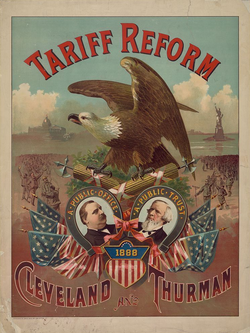
Tariff reform was an important issue in the 1888 Presidental election that resulted in the victory of the Republican candidate  Benjamin Harrison

The question of protectionism was a key part in the debate between the Democrats and the Republicans alongside the issue with slavery before the American Civil War between 1861 and 1865. The economy of the Southern States was based on exports of goods such as Cotton, Tobacco, and Sugarcane to Europe, this was done predominately by Slave Labour like it has been done long before the declaration of independence on the 4th July 1776. The Southern Slave owners and Democrats in the United States in the period before the Civil War believed that tariffs would lead to the imposition of tariffs on the United States by foreign nations that would render the economies of the deep south uncompetitive. The Economy in the North was based more on heavy industry in states such as Illinois and Pennsylvania where its economies were modelled in a similar way to the United Kingdom. Following the Civil War Republican dominance in politics ensured dominance on protectionist policies despite the pro-free trade policies of some following Democrat presidents such as Woodrow Wilson.
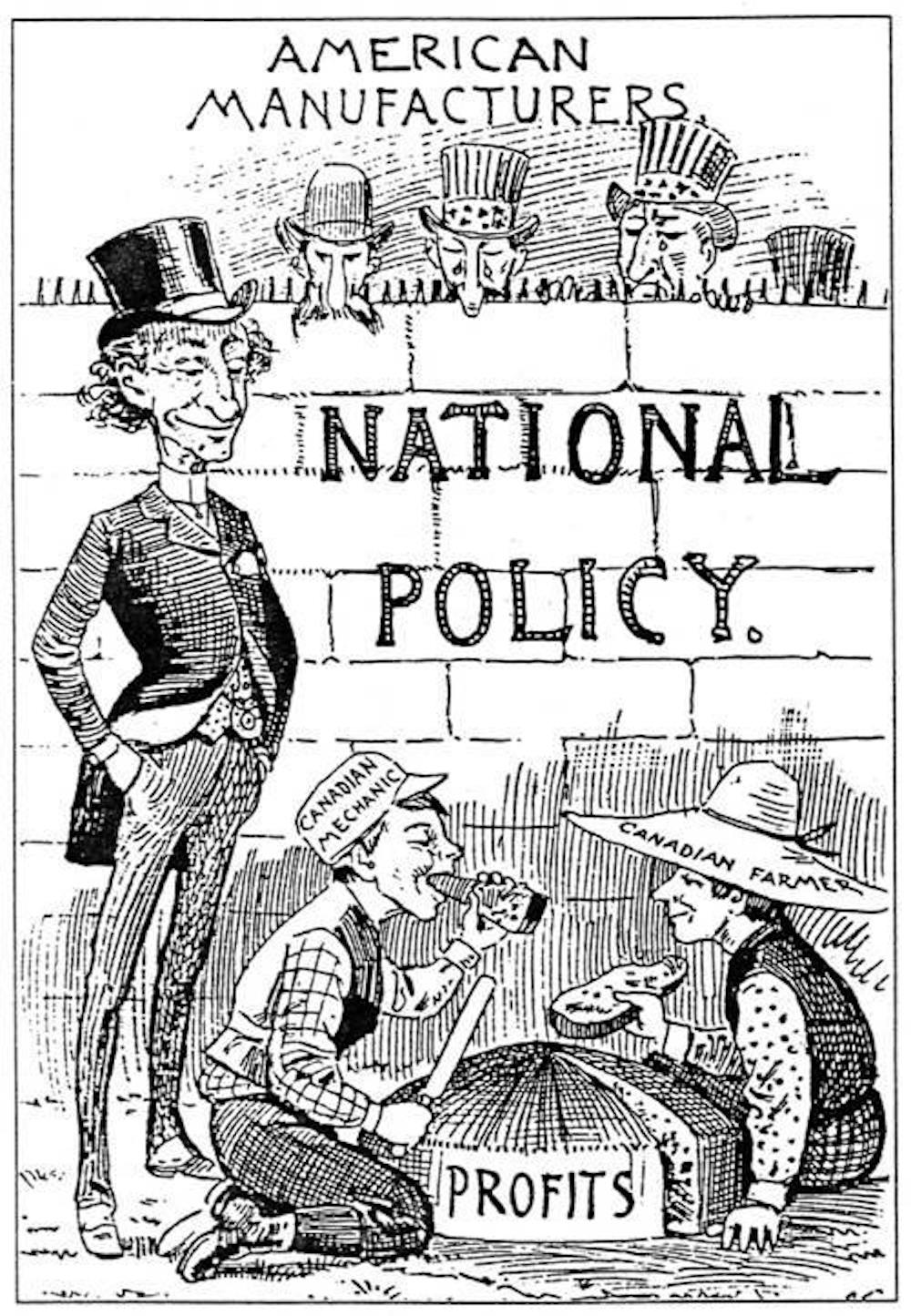
Image result for American protectionism poster
This Canadian poster from 1891 suggests that a policy of tariff retaliation against the United States is needed to protect Canadian Agriculture. 

The Great War greatly benefited the American economy.  The United States, in the need to fuel their war effort the allied nations imported goods from the United States on mass. The total value of U.S. exports grew from $2.4 billion in 1913 to $6.2 billion in 1917.  The continued attacks by the German submarines on American merchant ships exporting to Europe led to American involvement in the in the war in 1917. Woodrow Wilson was not a protectionist, he was both pro-free trade and was a Democrat. Woodrow Wilson was not an isolationist too, he believed in more international intervention and he came up with the idea of creating internationalist organisations to bind nations together such as the League of Nations. Woodrow Wilson created the League of Nations in 1920, however, due to pressure at home the American Congress was against American membership popular opinion in the United States moved towards isolationism and more protectionism.

The Wall Street Crash of 1929 was the greatest stock market crash in the history of the United States. It led to a 12 year long great depression that affected many western economies. In the United States, unemployment peaked at 25% in 1933. In a response to the Great Depression, the United States introduced even more protectionist Policies. One example of this is the Smoot-Hawley Tariff Act of 1930. This intended to protect American businesses and farmers suffering from the Great Depression. In many respects this was counterproductive. Many European countries despite being tied to the United State through war debt from the Great War (The United Kingdom even defaulted on the debt) in introduced protectionist policies both in the response to the United States and the Great Depression.

The Smoot-Hawley Tariff was controversial when it was introduced in 1930. Most economists believe that it made the Great Depression worse.

The move away from protectionism in the United States began after the Second World War. Free Trade was used to bind the Capitalist economies together against the Soviet bloc. After the Second World War, the old European Imperial powers lacked much of their pre-war ability to compete with the economic powerhouse that was the United States of America. This was apparent in the Suez Crisis where President Dwight D. Eisenhower in 1956 where the decaying Imperial powers of France and Britain failed to hold their own against American demands of their withdrawal from Egypt. The United States threatened to sell the US Governments Pound Sterling bonds. This would have significantly weakened the British economy. America was not threatened by foreign competition. The 1946 Anglo-American Loan also tied the United State and Great Britain and its colonies together economically, it prevented drastic hikes in tariffs to prevent and trade conflicts in the future. The Loan was supported by Britain as it enabled the nation to build its Socialist welfare state under the Attlee Government between 1945 and 1950. The United States also was one of the nations in the general agreement of trade in October 1947, which lasted until the creation of the World Trade Organisation in 1995.

The United States was the centre of the Capitalist world. It championed Free Trade between western capitalist nations and encouraged it. American Marshall aid tied European economies together and led to the creation of the European Coal and Steel Community in 1951, this economic union led to the creation of the European Union. It was not until the presidency of Ronald Reagan who changed economics in America into Neo-Liberalism instead of the new deal economics that was championed by Franklin D. Roosevelt. That the United States began to use protectionist economic policies to economies that threatened the United States, even if he championed free trade. Reagan imposed high tariffs on Japanese auto goods. While there was a growth of a strong protectionist wing in the Democrat Party.
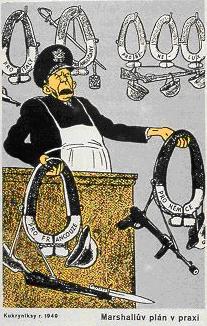
A Czechoslovak propaganda poster against the Marshall Plan. The title is can be translated as The Marshall Plan in Practice.
In the Post-Cold War America briefly enjoy existence as a sole global economic superpower with one global economic system of American style capitalism across the world. Globalisation was brought American goods and influence on every corner of human civilisation.  However, the decline of the United States began instantly after this process. The early 21st century brought about the rise of economies in the far east, this was particularly the case with the rise of China. China until 2016 was the fastest growing economy on Earth, it is now currently the largest economy on Earth. While for decades American manufacturing has gone into rapid decline. The Industrial heartland of the United States is now referred to as the rust belt.

The election of Donald Trump in the United States was a shock to many. His election should not be a shock. Many people felt left behind in the United States and they wanted someone completely different to the political norm, take the example of Pennsylvania for example, it is considered a rust belt state that delivered Republican electoral college votes rather than Democrat ones in previous Presidential elections. The election was also brought about the dreadful campaign by the dreadful candidate Hillary Clinton. That was backed by big business and Wall Street who was the wife of the previous president Bill Clinton. Hillary Clinton was also an extremely corrupt Secretary of State. 

Trump sees himself as an anti-globalist president. He has imposed tariffs on countless countries in the so-called name for fairer trade. He wants to "Make America Great Again", slow down the inevitable decline of the United States. The three countries/trading blocs he has focused on is tariffs on are Mexico, China and the European Union. Trump believes America has been unfairly hit by free trade, Trump also feels that the United States has been conned by previous Presidents that allowed the rise of the BRIC economies in the expense of the United States. Trump has forced a re-negotiation of NAFTA until a new trade deal. Trump has pulled the United States out of Trans-Pacific Trade Partnership and has considered re-joining if the deal can be re-negotiated. Trump is also keen, to have a Post Brexit trade deal with the United Kingdom.
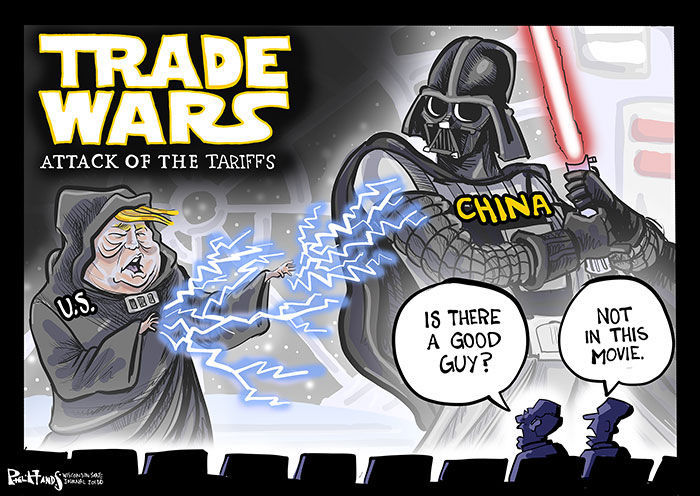
Image result for Trump trade war cartoon
This cartoon perfect depiction of the current situation between the United States and China after Trump imposed tariffs on China.
To conclude this essay, I will briefly discuss what is happening with Trump and his trade policy. Trump like Reagan aims to protect American industries from overseas competition. Trump like him or loathe him aims to restructure the global economic system in favour of the United States, Trump wants a revitalisation of the American Dream and Capitalism. He appears to want protectionism for certain professions that have been in decline in the United States particularly in Manufacturing. He appears to have a Libertarian light vision for the global economy. During his election he flirted with the idea of pulling out of many internationalist organisations, this has not happened. America is not turning Isolationistic. America under Trump appears to be more jingoistic and militaristic. In a way, Trump is trying to mimic Reagan. Reagan supported a Star Wars programme to protect the United States, Trump wants an American space force to enable American domination in space. Overall, I think Trump is only using protectionism as a tool in favour of the United States and his ideological worldview.

Monday, 22 October 2018

What we should do with Brexit at this current time.

I wrote before a few weeks ago what is most likely going to happen with Brexit. Now I am going to write a short piece on what we should do today. As of the time of writing this, we are in late October the extended deadline given by the EU for a deal is in Early November. We are clearly in a difficult position brought about 2 years of incompetence by the Conservative Government. People from all aspects of society are extremely dissatisfied by the performance of the Conservative Government. The Minority Government has struggled to keep its Party together with the Conservative Party on this issue with dissatisfied Pro Europeans and Eurosceptics. The Government has struggled to keep its DUP partners on the side of the Government who has kept the Government in power in a supply and demand deal on key votes in parliament.

There are several things that the left have been considering at this stage. The Peoples Vote is a subject that is gaining ground amongst some groups, this is very problematic.  Firstly, we would most likely vote the same we that we did on the 23rd June 2016, depending on the terms of the vote. Secondly, the Peoples Vote will be even more toxic and divisive than the first one. The first referendum divided people across the country and tore families apart. We should examine the nasty debate from the first referendum while, we did not debate the core issues around EU membership and a future vision for this country, instead both sides used a fear style campaign based on project fear either on immigration or economic apocalypse. I am not opposed to the concept of direct democracy and people having their say on the future relationship on EU membership, however, I am against the idea of having another referendum without honouring the first one and carrying it out. I do understand how problematic that is if we consider the complexity around EU membership, I think as a society we should do more to encourage a discussion on the future direction of this nation. However, I do support the idea of voting on the type of deal that you want, whether that is Theresa May's Chequers, Canada ++++ (whatever that is), or even a No deal. I think it's better to have a general election to deal with these issues, were we can have a real discussion on what we can do post-Brexit, a left-wing vision a right-wing vision, or perhaps on the idea of remaining in the EU. Currently, in this nation, we have so many domestic issues that in the viewpoints of most people in this country are simply more important than Brexit.

We need to take a position against many failing Neo-Liberal globalist institutions across the globe, that includes the European Union and other institutions such as the IMF. We currently have huge global challenges to deal with, which we will need to interact with countries across the world. Therefore, we need to encourage the growth of institutions that bring countries together on issues such as climate change. We are currently doing little to solve these issues. Tony Benn talked about the creation of a Commonwealth of Europe based on co-operation with other countries on these issues. This is an idea that we should pursue. We should also maintain and even better improve the current legislation of the European Union. One example of this is the Environmental Liability Directive.

Many people on the left believe in the idea of a Social Europe, the idea of using the EU to protect workers’ rights for instance. This is a rather noble idea. The European Union in this concept can be used as a barrier and a check and balance to the policies to any regressive Conservative Government in power. Since the late 1980's the majority of the Labour Party has taken this position. The European Union has led to more workers’ rights, take the working time directive for example which are not terrible ideas. We should be aiming to maintain these and improve on these laws post-Brexit. The British people have a responsibility to elect a Government that will protect these rights. We should go about also empowering Trade Unions and encouraging the idea of collective bargaining as a viable check and balance.

I think that complaining about the lack of democratic accountability within the European Union and the institutions associated with it without looking at the failures at home. This will not be turned into a discussion on how the European Union operates, I think it's more important at this point to look at affairs at home. We have a lack of transparency in Government, Parliament and in our institutions. We have a political system that is biased towards London and the South East. We have an unelected second chamber the House of Lords, we have the House of Commons that is not entirely representative on the views of the British people due to the First by the Post electoral system. We also have an unelected Monarch, in many ways our constitution is still quite medieval in its nature. Many people during the referendum saw the European Union as being a foreign institution above Parliament. It was not foreign institution since we did have a role moulding the current European Union at it is today, but it was another institution that acted with and above parliament. This often-clouded judgement on who to blame for a specified issue, sometimes the EU was a fault and sometimes It was the British Government for a policy that some members of the British public did not approve on. Take Immigration and then, EU competition rules that would limit what a left-wing Government could nationalise. In Post Brexit Britain we need to make it clear who we should hold to account we so can create a better future. I do recognise that many politicians did take the EU for granted this way, so people blamed the EU for a problem at home or a problem that the British Government can solve with the EU.

The reality is this nation is a broken nation, in a broken global economic order and the debate on Europe should be how to fix these problems. We have major internal social, economic and political problems. We have major economic problems such as low productivity, a decline in real wages. economic deprivation, a trade deficit with most of the globe. Our Political system is in dire need for reform just look at the Monarchy, the house of commons, local devolution, the voting system and the House of Lords for starters. For our own societal problems, we can look at, education, our media, our culture, or identity and just the general anger and confusion that the public has. Consecutive Governments has failed to solve these major problems. Many people feel disconnected to Westminster and to a greater extent London, people feel more English, Scottish, Welsh and Irish/ Northern Irish than they did in the past, there is a general confusion about British identity, many people have claimed Brexit was a result of an English Identity crisis, the reality is there is a British identity crisis. This idea has come about from individuals that feel disconnected from society. People feel left behind.  Much of the wealth in our economy was concertinaed in London and in the city of London, approximately 80% of the wealth of this nation is created in London from the financial sector. Much of this wealth does not touch most of the British population. We still live under the Neo-Liberal style economics introduced in the 1980's in this country by Margret Thatcher as she transferred this economy to a service sector economy rather than an industrial manufacturing-based economy.        

 Many of the former Manufacturing areas of the United Kingdom still are some of the most economically deprived areas of the United Kingdom. Many areas receive a lack of investment from both the Government and the private sector. In some former Industrial towns, wages have decreased on average since 2010. Many people felt that they had their futures were stolen and their local areas robbed of their wealth. Many older individuals in Northern Industrial towns and cities believe they were better off before the 1970's before Thatcherism and before we joined the European Community. I think the main problem we see currently is the vast economic imbalances we see in this country, the British economy is too based towards London and regional centres, Investment in our economy has remained stagnant for decades, working rights have been stagnant due to the destruction of the rights of the trade unions, the lack of skilled high paid work, the commercialisation of education. I could name many more issues such as our trade deficit we are in a situation that we are completely stagnating as a society compared to other nations in the west. Many of these issues go side by side with economic liberalisation in the west and a lack of any form of intervention to deal with the negative effects that go side by side with the rise of the East Asian economies. We need to look for a brand new and radical economic direction in this country that benefits most of the British population. We certainly need to move away from supply-side economics that has failed to deliver on its promises that the wealth from the rich will trickle down to the poorest in society. The question that we must ask ourselves is how to achieve this? Corbyn's Labour Party offers a Neo-Keynesian economic vision for the country, a reformed version of the post-war economic conscious that is suited a modern world that must deal with global issues.

We should also look at the ideas of reforming and/or creating an alternative organisation to the European Union at its current state. How do we change the European Union as it is presently constituted and if we can what do we change it to?  That is a very difficult question to answer even for Yanis Varoufakis or can we create another institution that workers in a more democratic and benevolent manner without the Neo-Liberal economics attached. This has always been the position of Tony Benn on Europe to create an alternative Commonwealth of Europe based on voluntary co-operation on key issues that affect the continent of Europe at large and this is the idea I think the left should be open to. Regardless, we are going to need to work with DiEM25 the only organisation that currently would reform the EU in a progressive way if it had the chance. The major problem we have with all of this is that there is a lack of a discussion of Europe in this country. We focus too much of immigration and the migrant crisis, we don't talk about that Italy has not had direct control over its treasury for years, we don't talk about the EU forcing austerity measures on countries such as Cyprus.

This essay was a brief discussion of what we should do with Brexit, please if you are reading this, share your thoughts and ask me any question on the subject. I will just conclude this issue by explaining what we should do now as a nation. We should join EFTA until we can have a unified position of what we should do in the long-term future. We should not join the EEA this will require us to join the Schengen Area. EFTA will keep us in the single market but outside a Customs Union, countries such as Iceland are in EFTA. This will solve the issue with the Northern Irish border and will maintain the status quo at large economically while bringing more power back home to Westminster e.g. on fishing and agriculture. Then we should have a real debate on what should we do with regards to Europe. We also should note that revoking article 50 to anyone who wants to stop Brexit may require another negotiation. Being outside the EU itself we would not be tied to the European Union and hence any re-negotiation in the future in these terms will put us in a stronger position. Joining the EFTA would require little negotiation and the transition into it would be rather smooth compared to the likelihood of what the Tories are likely going to do with Brexit. In EFTA for the next few years, we should aim in my opinion to have a meaningful free trade deal. Where we return decision making to Westminster and devolved administrations.  We should also create a brand new British alternative to the ECJ during this process with a similar role. Thanks for reading.


Tuesday, 9 October 2018

Global Neo-Liberalism a brief overview

In the 1980's and in the 1990's following the collapse of the Soviet Union most nations on Earth underwent a mass market liberalisation process. Most countries accepted the concept of Neo-Liberalism and Globalisation as the natural order. There was a narrative that you must lower taxes and empower private enterprise at the expense of the public sector. There was an idea that you should undermine your own industries by allowing your own manufacturing to move to China and the Asian Tiger economies. Many workers in these economies are being exploited in many countries like China they have little rights and many workers are forced to work in sweatshops with long hours with little pay for our own privilege in buying cheap goods. Many people not just in the United Kingdom felt left behind. In many western countries, these jobs were replaced with unstable service sector jobs since it was no longer competitive to have any form of major manufacturing industry. As people gain capital from the increasingly automated stock markets others grow rich from a rapid increase in borrowing for mortgages that many people could not afford. Much of the capital used for mortgages were created by the banks. see fractional reserve banking. Of course, the financial bubble went bust in 2008 it was the largest crash since the Wall Street crash of 1929, it was caused by a collapse of the housing bubble in the United States. It marked the end of global capitalism. The crash pulled a rug under the system. We had mass opposition to the system with the occupy movement where average people demanded more transparency and control over the capitalist system. Neo-Liberalism failed in 2008 but was resurrected by a series of intervention by the Neo-Liberal Western Governments. In 2008, for instance, Prime Minister Gordon Brown bailed out the banks for a total of £500 Billion. For the exception of Iceland, the perpetrators of the crash across the west got away with their crimes and incompetence, many kept their banker's bonuses. If the bailouts did not occur it is true that people would have been economically worse off, one could say with some of the policies implemented by Gordon Brown at this time saved the British economy from the fate of the Eurozone countries in the following years. The general response of those in power was not to punish for but the burden of the costs of the 2008 crash on the people who are responsible or those with the broader shoulders to pay for the crash. But the choice of the wealthy Neo-Liberal establishment, particularly across Europe to pay for the robbery at the hands of the bankers in 2008. Unlike in other countries in the United Kingdom, the British Coalition Government voluntary chose to undergo a disastrous policy that harmed working class people in all aspects of society. Overseas the issue was different, the European Union forced certain Eurozone countries to undergo austerity, Greece, Portugal, Cyprus and Italy to name a few. Greece even today has not recovered from the events of the 2008 crisis only in 2018 is when the economy has started to see some flickers of improvement. The International Monetary fund and the World Bank still back the Washington consensus that supports Privatisation, austerity, "so-called marker liberalisation processes" that these rich Bilderberg bankers seem to think it is good for the workers of the globe. As I write this on 9th October 2018 Argentine workers are striking against a possible IMF loan that will impose austerity on Argentina. We need to rethink the entire economic conscious that we built up after the war. We need to rethink globalisation and how we do things on this planet. This is simply not sustainable. At the time of writing this there is multiple times more debt than physical money in existence, this is another bubble waiting to explode. The aim of the internationalist left is to look towards reforming or even leaving these institutions. These people work for their won interests and not the interests of the workers. We are living in the time where Social/economic and even cultural inequality is increasing. Many of the global economic agreements do need some rethinking such as the Bretton Woods agreement. In many cases unrestrained capitalism is also polluting and wrecking the planet many scientists believe we are entering a 6th mass extinction. We have a lack of creativity and a lack of imagination to change our current situation and this will be the greatest barrier to change. You have to remember the ideas of Neo-Liberalism was developed alongside the ideas of Keynesian economics in the 1930's it actually spent decades on the fringe until the rise of Margaret Thatcher and Ronald Reagan. It was the philosopher Alexander Rüstow that came up with the idea of Neo-Liberalism that had the idea of having an economic system in between controlled social and economic forces and classical liberalism.

Wednesday, 3 October 2018

What May happen in 2019 and with Brexit in the short term.

Brexit and politics of the United Kingdom within the next year

The following points and ideas are what I think what would most likely occur within the next year. I will firstly begin introducing what is Brexit and why we voted to leave the European Union, then I will discuss what is likely to occur at the writing on this essay in early October 2018.
Brexit is short for the British exit of the European Union.  It is the idea that Britain could leave the European Union and bring back many of the powers that have been acquired by the European Union since the United Kingdom had joined the EEC in 1973. The United Kingdom of Great Britain and Northern Ireland voted to leave the European Union on the 23rd June 2016. 2016 was a hectic year for the western establishment, the year the establishment failed to get their own way on both sides of the pond. It was a clear backlash against the Neo-Liberal economics which was set up in the 1980’s that replaced the new deal style economics in the western world. Many economists call this either supply-side economics and its critics trickle-down economics.  The name of this does not matter. What matters is that this economic position has failed the majority of people in the west. Many people were left behind for decades the same people left behind lashed out at the establishment that told them that everything will be worse when themselves were the real reason for the anger against the establishment. For this very reason it those in power want to remain in place, the elite must adapt and recognise the ills of the working class. In a divided country there must be a mechanism to unify the nation and to pick up the pieces created by the economic incompetence of the political class. We need to build a society that is not about dog eats dog but a society where everyone cares about each other.

 The current negotiations with the European Union could not be handled any worse than it currently is. In power we have a clueless and directionless party who put their own personal interests and their careers first. The Conservative Party lacks new ideas and different methods to solve and address the issues of the time. They lack imagination and the Conservative Party fails to look outside the box on these issues. The question of Europe has always been the Achilles heel of the Conservative Party, well certainly at least the Post Thatcher years. The 2005 Conservative Party leadership election was thought on the issue of Europe between David Cameron and David Davis. These divisions became so extreme that 2 Conservative MPs Mark Reckless (it’s in the name) and Douglas Carswell defected to UKIP. The fear of more defections to UKIP led to the promise of a referendum by the Conservative leader David Cameron after the 2015 general election. This referendum was called in 2017, it brought out the ancient divisions in the Conservative Party into the public sphere. It led to one of the most toxic debates in history. Furthermore, it brought out career interests in certain Conservative MP's, this was the case with Boris Johnson and Michael Gove. The Question is why is this relevant? It’s quite simple, the future of Brexit and the future of the Conservative Party. The idea that I am advocating is that the issue of Europe will finally bring down the so-called "unified unit" of the Conservative Party. I would argue that these divisions, contributed to the confusion to what it’s the ideological direction and the plan for the future for the Conservative Party. I think this sensation resonates with Conservative supporters, I constantly hear many Tory voters that say that the Conservative Party is no longer Conservative. Theresa May when she became the Conservative leader emulated Ed Miliband in her first speech as Prime Minister. Though this was a clear attack on Labour at the time. This is important to think about to determine what is going to happen with the future with Brexit.
At the time of writing this, the United Kingdom has entered a place of uncertainty. Theresa May’s Brexit plans have been rejected by the European Union. The Chequers proposal was supposed to be the way to leave the European Union and supposedly honouring the vote without impeding the economy. This proposal was hated by both sides of the divide on Brexit. Chequers was proposed on the 6th July 2018 after 18 months of little progress in the Brexit negotiations. Except for the so-called divorce bill at £39 billion though this figure is likely to rise. In September 2018 Theresa May met with Michel Barnier in Salzburg in Austria the EU flat out disagreed with the Chequers proposals. Prompting Theresa May to discuss the potential of a No deal. With this period of uncertainty, the purpose of the following discussions is to talk about what is likely going to happen with Brexit.
The main part of the discussion is the leadership of the Conservative Party. Since the 2017 election people have discussed when is May is going to leave office. Who will challenge Theresa May and who is going to be her successor. Moreover, despite threats to oust Theresa May for the last year she remains in power.  There have been a handful of potential successors that have been an important part of the political discourse. We have Jacob Rees Mogg who has been discussed for the last year, however, he his firmly behind Boris Johnson. We have Boris Johnson who has manoeuvred himself to become the Conservative leader since the EU referendum, especially since he resigned from his position as Foreign Secretary. Boris Johnson is the most likely successor to Theresa May. There are also a few more possible candidates such as Sajid Javid, David Davis and Andrea Leadsom. Since becoming the Home Secretary after Amber Rudd resigned due to the Windrush scandal Sajid Javid has been posed to become the next Conservative leader. The issue with this is the majority of the Conservative membership are mainly Brexiters and internal polls suggest vast levels of support for Boris Johnson.

Another question we need to look it is the departure of Theresa May. Her track record suggests that she will remain Prime Minister. Most key votes in Parliament despite threats of rebellions go in the Governments favour.  Most possible leadership contenders such as Boris Johnson prove time and time again to be spineless when trying to oust May or undermine her leadership. Theresa May is one of the worst Prime Ministers we have had in modern history but at least she knows how to stay in power. The likely hood of Theresa May being ousted is low. I think most Conservative MP’s despite what happens with Brexit do not want to cause the Government to collapse and risk another general election where they are bound to lose. I think Theresa May will stay in power until early April where she will resign though her own free will after we are currently due to leave the European Union.
After examining the membership of the Conservative Party, it is certain that a Brexiter will become Prime Minister. Internal polls within the Conservative Party show support for Boris Johnson to become the leader of the Conservative Party. Boris Johnson is the most likely candidate to become Prime Minister. A leadership election in 2019 would not be as quick and divisive as the last one as of the candidates stepped down in favour of Theresa May. Instead of taking less than a month to conclude the next Conservative leadership election would be a longer process and the final vote will likely go to the membership and it will be a longer process. I think Sajid Javid, Dominic Rabb, Boris Johnson, David Davis, Michael Gove and Jeremy Hunt will show interest in leadership. Jacob Rees Mogg would be firmly behind Boris Johnson, Mogg would likely have a cabinet position promised to him. The final two candidates would either Boris Johnson and Sajid Javid, Boris Johnson and Dominic Rabb, Boris Johnson and David Davis. I think Boris Johnson will become Prime Minister in late spring/ early summer 2019.

The likely key cabinet positions under Prime Minister Boris Johnson is as follows.

Prime Minister- Boris Johnson
Chancellor of the Exchequer- David Davis
Secretary of State for Foreign and Commonwealth Affairs- Jacob Rees Mogg
Secretary of State for the Home Department- Andrea Leadsom
Secretary of State of Work and Pension- Esther McVey
Secretary of State for Transport- Ian Duncan Smith
Secretary of State for Environment, Food and Rural Affairs- Michael Gove
Secretary of State for International Trade- John Redwood

The most important predictions we must look at is the likely Brexit deal. Let’s make this clear there will not be a no deal Brexit, there is no majority in Parliament for it. EEA membership is out of the question as it requires for the UK to join the Schengen Area. EFTA is a more likely soft Brexit option as the UK is a founding member and it does not require the UK to join Schengen. However, I think the recent rhetoric from Theresa May suggests we will not get a deal like EFTA. My prediction with a more of a Canadian style deal with a new Customs Union or Chequers with a Customs Union to prevent a hard border in Northern Ireland. At the time of writing this Theresa May has suggested we could remain in a Customs Union post-Brexit. This would be negotiated at the last minute in an attempt to prevent a No deal Brexit or a second referendum. This would most likely be just before Christmas like the divorce bill agreement in 2017. I see both the UK and the European Union both compromising on key issues at the last minute. I think the EU would be under a lot of pressure from Germany and the car industry to gain a meaningful deal.

Another issue we need to put to bed is the idea of a new general election. There has been endless speculation of another general election after the result of the 2017 general election. The idea of an early general election has resurfaced after the Chequers proposal and after the Chequers proposal was rejected by the European Union. It never occurred. The Conservative and DUP MP’s may have their differences on subjects such as Brexit however, they do not want to risk another general election and the placement of Jeremy Corbyn in 10 Downing Street. We can prove that this will happen from the track record in votes in parliament where the Government has managed to defeat the opposition in key votes in parliament even when there was an expectation for a major Conservative Rebellion. The Labour Party is going to aim to trigger a general election at all costs, I think this will fail. As the Peoples Vote motion mandates, Labour will also attempt to trigger a Peoples Vote, unless we get a No Deal, which I stated above is incredibly unlikely. The Conservatives will be able to push their Brexit deal through Parliament through the skin of its teeth. The next general election will likely occur in autumn 2019 after the summer recess and the end of the DUP deal and after a Conservative leadership election.

In this section, I will discuss the internal politics of the main Parties except for Conservatives as I discussed the Conservative leadership above. The SNP will likely have a change in leadership in 2019 due to an increase of dissatisfaction towards Nicola Sturgeon. The SNP are increasingly split between the prospect of an Indyref2 and divisions between pro-Alex Salmond and Sturgeon factions in the Party. There is also a growing split in the SNP on Brexit on the SNP’s policy towards it and on the Question of what will be the relationship between the EU and an independent Scotland? The popularity of the SNP will go into decline in favour of Labour and the Liberal Democrats. As well as Theresa May, Vince Cable will stand down in April 2019 as the leader of the Liberal Democrats, he has already announced he would resign after Brexit is either resolved or stopped. He would likely be replaced by Jo Swinson or Layla Moran. In term of popularity, I think the popularity of the Liberal Democrats will go into decline after Brexit in favour of Labour and the Conservatives. Jeremy Corbyn will strengthen his leadership in the Labour Party. Labour popularity will only increase in the next year after more Tory failures become highlighted in the media. In the 2017 general election, Labour did well directing the debate away from Brexit. Without the toxicity of Brexit Labour will excel in the polls. Discussion in Labour will be directed in new ideas such as abolishing the Monarchy and the idea of leaving NATO will come up. Open reselection will be passed in the 2019 Labour conference just prior to the 2019 election. The moderates in Labour will accept Labours new position like the left did with Blair many of them will give up in undermining Corbyn. Many of the deselected and dissatisfied moderates will leave Labour but this will not affect it electorally instead they will attract the moderate Conservative vote. A new centrist Party will emerge, backed by figures like Alistair Campbell and David Miliband, they will bring forth the idea of coming back into the European Union. I think this will draw key supporters from Labour, Conservatives and the Liberal Democrats. I can see many of the social democrat types in the Liberal Democrats move to this new Party in the long term I can see an emergence of the old Liberal Party values within the Liberal Democrats. The new Party will be modelled on Emmanuel Macron’s La République En Marche. This new Party has a chance of winning a few cities however I can’t see it gaining more than 8% of the vote.

This section will briefly suggest what is likely to occur with our economy when we leave the European Union and what will be the policies that the Government would enact as a response.  There will be a temporary crash in the value of the Pound Sterling in early 2019. The Pound Sterling will increase in value as long as there is certainty, I will have a temporary surge in summer 2019 until the 2019 general election. The election of a Labour Government would lead to the Pound Sterling to crash again in value. Imports will become more expensive between the UK and the EU after the UK takes its seat on the World Trade Organisation we will aim to unilaterally lower tariffs on food imports to make up for the shortfall in imports from the European Union. I think the foreign investment will increase from the United States and China which both countries will take advantage with lower tariffs with Britain. However, this will not replace the investment losses due to Brexit in the short term. While we will be in a sort of a customs union, we would be allowed to make our own trade deals as long as we can prevent goods sourced from the outside of the EU from crossing the border. I think we will get a Trade Deal with the United States rather quickly and the terms of the deal would be a key debate in the 2019 general election.  I think the deal with the United States might include the proposed Space force and in agriculture, Boris Johnson is going to think big with his deal, after all, be seems ambitious with his numerous proposed bridges. Austerity measures will continue after Brexit in the public sector, however, I can see the Tories doing everything they can to keep the Post Brexit economy growing, there will be the largest increase in investment in since the 2008 crash. Much of this would be paid for a reduction of foreign aid.  As a result, we will have high inflation in 2019 perhaps the highest inflation we have seen since the 1970’s. I can also see the bank of England keeping interest as low as possible to encourage borrowing and to keep prices of housing and goods low. A decline in property prices post Brexit is also likely, due to the increase in house building and the decline in land banking from EU investors.  The Government is going to provide incentives and interest free loan schemes to a desperate attempt to get the Post Brexit economy going. This will be particularly impactful in London. Net Migration will go down, due to an increase of migration to outside the UK and a decrease in immigration to the UK. Immigration laws will not change in 2019 they will stay essentially the same than before to outside the EU. The service sector of the economy will go into decline for the first time since 2008 and there will be a slight increase in productivity amongst manufacturers that export outside the European Union.  I think this would be in new green and high-tech industries’ Conservative Government will encourage consumers to buy British Goods rather than imports from abroad and due to the increase in costs from imports we could see a small resurgence in British manufacturing. I can’t foresee major changes to Agriculture in this country we will leave the common agricultural policy and the Government will likely maintain much of the subsidies that the EU give to farmers. The fishing industry will do better outside the common fisheries policy, however, a situation similar to the Cod wars with Iceland with British and EU fishermen that continue to fish in British waters despite any agreement with the EU and the UK. Economic growth after Brexit will be extremely low, we will escape an economic recession by the skin of our teeth, perhaps at around 0.1% growth. However, I think things will quickly improve in following years. An increase in unemployment is inevitable in 2019 and will key part in a Political debate in 2019 due to the inevitable economic changes to this country as we leave the European Union.

That is the basic economic prediction in 2019, I would love to see what you think about this, we will see great economic difficulty however we will see the growth of new industries. There will be a massive disruption in customs as we will struggle to gain the administration to cope with exports and imports to the European Union, however, this disruption would he short term over the first half of 2019.

I can see a general election being called in September or October 2019, with the disruption of Brexit and a Conservative leadership contest I can’t see one being called in summer 2019. It would be a long a partisan campaign, however, it will result in a Labour Victory, Labour will have between 290 and 320 seats. It is possible that Labour will be forced into a supply and demand deal with the Liberal Democrats or the SNP in return for concessions most likely on voting reform and devolution. The election will be fought on key policies and there will be a backlash to Conservative failures with Brexit and young population that overwhelmingly supports Labour and a backlash against 8 years of austerity.

Saturday, 1 September 2018

The Bevanites and the Gaitskellites

 This subject is, of course, relevant to modern day politics within the Labour Party, especially at this current time when we have MP's such as Frank Field resigning from the Labour MP and the constant talk about a split in the Labour Party. I fundamentally believe that the current Labour Movement must learn from the mistakes from this time period if it is to succeed in the future and deliver the programme that the working classes of the United Kingdom desperately need.

What is happening now in the Labour Party is rather similar to what happened in the late 1950's. Instead of the Blairites and the Corbynites, we had the Gaitskellites on the right of the Party and the Bevanites on the left. The Bevanites were popular amongst Party activists. The Bevanites were extremely similar to Corbyn supporters today in many ways, they are were grossly split on issues such as Nuclear weapons, we can just examine the debate on Trident today in Labour to get the feeling on that. The Bevanites were followers and supporters of Nye Bevan and this faction included individuals such as Michael Foot and Tony Benn. Gaitskellites who were led by Hugh Gaitskell the were opposed to nationalisation and were in favour of a more of a market-orientated economy. They controlled the economic position of the Labour Party in the 1950's until Harold Wilson became the Labour Leader. Generally, the Labour grassroots was dominated by the Bevanites and the Parliamentary Labour Party was dominated by the Gaitskellites.

Image result for Nye Bevan
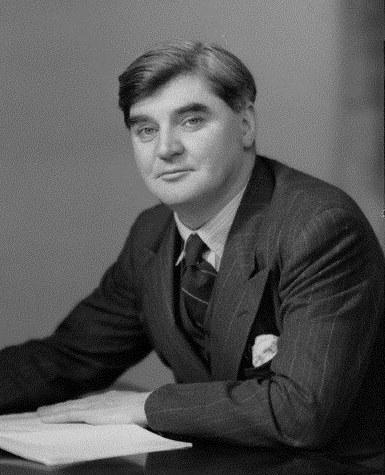
Nye Bevan was the  Minister for Health in the UK from 1945 to 1951 during the Attlee Government and it was Nye Bevan that created the NHS in 1948

The main split between them and the Bevanites was caused by Gaitskell's budget of 1951 introduced charges for certain prescriptions on the National Health Service. Parallels can be drawn with Tony Blair and PFI contracts that led to the slow privatisation of many services in the NHS that continue today in 2018. The Labour Party out of all Parties began this process that the Conservatives continued in a coalition backed by the Liberal Democrats between 2010 and 2015 and the Conservative Majority and Minority Governments since that coalition. The majority of the centrist faction of the Labour Party is morally bankrupt.

"The NHS will last as long as there are folk left with the faith to fight for it"- Nye Bevan

Labour in 1951 had a Majority Government of 5 seats what was fundamentally split Labour in 1951 called a general election and lost 20 seats despite winning 200,000 more votes the Conservatives acquired a majority. A failure of first past the post. This led to Winston Churchill's second tenure of Prime Minister until 1955 when he retired and was replaced with Sir Antony Eden.

 Two graphs of the vote share and the seat share of the major Parties in the 1951 general election. Sourced from Wikipedia.

Hugh Gaitskell became the Labour Leader in 1955 after the retirement of Clement Attlee after Labours defeat in the 1955 General Election. Sir Anthony Eden increased the majority of the Conservatives. Like in the 1980's these defeats led to Labour moving to the right.

Image result for Hugh Gaitskell
Hugh Gaitskell was the leader of the Labour Party and the leader of the opposition between 1955 and 1960. He was also the Chancellor of the Exchequer between 1950 and 1951 and was the Shadow Chancellor of the Exchequer between 1951 and 1955.
In the context of Brexit in modern British Politics of 2018, It is also important to note that the Bevanites was the faction that was against joining the European Economic Community in 1973 and the Gaitskellites were in favour of joining the European Economic Community, though Gaitskell himself was rather sceptical of the European project. Generally, the right of Labour has always been more Pro European and the left was more sceptical of European integration. Though in modern years this has changed and Euroscepticism in the mainstream Politics and in the media is dominated by the right-wing factions in the Conservative Party. The divide between the Bevanites and the Gaitskellites on this issue was obvious if you consider that the likes of Tony Benn were the key Bevanites in Labour at the time. Even today it is the right of the Labour Party that opposes a Jeremy Corbyn that demands a #PeoplesVote and a reversal of Brexit. This is a very old divide in Labour, that still resonates today.

Hugh Gaitskell was just as successful as Attlee in the 1955 General Election in the 1959 General Election. The movement to the right for Labour failed. Labour lost 19 seats. However, much of this could be credited to economic stability in the late 1950's. The same can be really be said about the 2015 General Election. The economy continues to grow and Labour remained a Neo-Liberal Party at its core and favoured some austerity measures. Like before 2015 election, before the 1959 election Labour was actually polling above the Conservatives. This was because of the Suez Crisis of 1956 that led to the resignation of Sir Antony Eden in 1957. As a result, Harold Macmillan became the Prime Minister of the United Kingdom.

A basic chart displaying the results of the 1959 General Election and the performance of the three major Parties. Sourced from Wikipedia.


Gaitskell just like Blair as the Labour Leader attempted to introduce many reforms to Labour but failed. One example of this is that he tried to change Labour charter's Clause IV that called for nationalisation. However, this was prevented by a strong Bevanite grassroots movement. Unfortunately, the Labour Party lacked a powerful Bevanite like movement in the 1990's. Blair like Gaitskell before him wanted to define what not only what British Socialism was but what the Labour Party was. This new Clause IV has remained in place since 1995 and even today it remains on the back of Labour membership cards. At the time Jeremy Corbyn opposed the proposed changes to Clause IV, however, at the time of writing this article Jeremy Corbyn has maintained the new Clause IV that was adopted by Tony Blair.

Below is the original Clause IV that was written by the member of the Fabian Society  Sidney Webb in 1917 and was adopted by the Labour Party in 1918. 

To secure for the workers by hand or by brain the full fruits of their industry and the most equitable distribution thereof that may be possible upon the basis of the common ownership of the means of production, distribution and exchange, and the best obtainable system of popular administration and control of each industry or service.
The current Clause IV below is the definition adopted by Tony Blair in 1995 the new definition abandons much of Labours Marxist roots for a more moderate constitution for the Labour Party. Still, the definition is broad and is fairly progressive. Note that it mentions "In the hands of the many, not the few", this was the basis of Jeremy Corbyn's campaign slogan in the 2017 General Election for the many and not the few. I suspect Gaitskell wanted a similar definition.

The Labour Party is a democratic socialist party. It believes that by the strength of our common endeavour we achieve more than we achieve alone, so as to create for each of us the means to realise our true potential and for all of us a community in which power, wealth and opportunity are in the hands of the many, not the few, where the rights we enjoy reflect the duties we owe, and where we live together, freely, in a spirit of solidarity, tolerance and respect.

  
Tony Benn in his Dairies in 1960 on the protental changes to Clause IV

The defeat of the Labour Party in the 1959 General Election vindicated the Bevanites within the Labour Party. In 1959 Nye Bevan was elected to the Deputy Leader of Labour where we remained until his death in 1960. He was replaced by the Gaitskellite George Brown. In 1963 Hugh Gaitskell died in office, he was replaced with Harold Wilson. Harold Wilson was a moderate member of the former Bevanite faction in the Labour Party but was a unifying figure who adopted some Gaitskellite polices. Harold Wilson was the Chancellor of the Exchequer between 1955 and 1961 he was seen as unifying between both factions many of the key Bevanites supported him. 


Grey-scale portrait of a middle-aged man with a round face and coiffed grey hair, wearing a dark suit


Harold Wilson ( Baron Wilson of Rievaulx). He served a term as the Prime Minister between 1964 and 1970 and another term between 1974 and 1976 

The 1964 General Election resulted in the first Labour Majority since 1951. However, Labour only achieved a 0.2% swing in the vote it was the split in the Conservative vote and the Liberal vote that largely propelled Labour into power. However, he was successful in getting the Labour Party into Government and reunifying both factions of the Labour Party. Many factional tensions in Labour did not resurface in the 1980's. Where many of the members of what was the Gaitskellite faction defected into the Social Democratic Party which later merged with the Liberal Party to form the Liberal Democrats in 1988.

Jeremy Corbyn did attempt to mimic this. Corbyn's first shadow cabinet included key Labour moderates such as Hillary Benn who was the Shadow Foreign Secretary under Jeremy Corbyn. He was sacked from the Shadow Cabinet in 2016 for organising a coup against Jeremy Corbyn that led to mass resignations from his moderate shadow cabinet members that a leadership election. While affairs were not as Partisan during the 1950's and the early 1960's is important to know these past issues that were extremely similar to the situation that Labour is in today. Despite all of that Corbyn still attempts to be forgiving to the moderate factions in Labour to the extent of compromising with them with policies such as on Trident. But these divisions remain extremely open. What Labour needs is a strong grassroots movement to counteract the moderate MP, who are more to the right than the old Gaitkellites.  Of course, Labour currently has that. However, it is less effective than the old Bevanite movement. It is not as radical as the old Bevanite movement and this new movement needs to do more to attract the old working class that. We need a mass revival of the old trade union movement behind a figure to the left of the Labour Party. We need to bring back the old ideas of mass solidarity between the working class. We also need to a way to get the influential  Liberal middle class, who have always been important to the Labour movement, particularly in the Fabian Society. However, Labour must be a working persons Party who puts the working class first. It is clear that we need to abandon but we must look to the past to learn from our past mistakes. Looking back to this period may give us insight to firstly unify the Labour Party and Secondly assist Labour in returning into its radical Socialist roots.


Thursday, 23 August 2018

The Working Class, Labour and Brexit


.                                                                                                                                                                   Free trade has made certain industries competitive over the years such as steel and shipbuilding. This as particularly the case in areas if the North of England that voted by the highest amount for Brexit. Most notably, in the former industrial heartlands. Britain’s version of the rust belt states that abandoned the Democrats in the United States. The British establishment became systematically unapologetic to these people. Traditionally, these areas of the country were strongly Labour, but Labour overtime became disliked for becoming too London centric and middle class. I think this process was a result of the policies and success of Margaret Thatcher and the rise of new Labour which many traditional Labour voters felt left behind by new Labour.

Due to the embracement of Neo-Liberalism and the migration policies of Tony Blair many working-class voters were driven to Parties such as UKIP, who by their very nature were the same Thatcherites that shafted Northern England in the 1980's, but just slightly Eurosceptic. For the first time in decades Labour was challenged in their safest seats, but they continued to take their voters for granted. Labour failed to recognise this issue under Ed Miliband who himself served Doncaster North that voted 72% leave. Miliband's constituency is typical of a former industrial constituency, the seat is covered in former mining villages and towns with abandoned factories. UKIP frequently targeted the area, for instance, they Farage's UKIP continuously put their conferences in Doncaster. In 2014 we saw the foundation of the Yorkshire Party which gained much of its popularity in the former industrial heartlands. Its appeal its is localism, as opposed to its London centric policies. The Yorkshire Party is perceived as a middle ground between old an new Labour, which many Socialists see it as preferable to the Labour Party.

The year 2015 was an odd year for politics, we received an unexpected Majority for the Conservatives, the election was disheartening for many working-class voters, hence many switched a allegiance to UKIP. The three main Parties, Labour, Liberal Democrats and the Conservatives fought the election a very similar platform to each other of Neo-Liberalism. Labour received a mass backlash in Scotland for the failures of Neo-Liberalism as Labour was left with one seat in Scotland where Labour traditionally relied upon and took for granted. The response within the Labour Party in 2015 was rather extraordinary. We saw the return to the traditional Labour with the unexpected election of Jeremy Corbyn against all odds. He would promise to transform Labour and take the Party back to its roots. Initially, he was only put forward as a candidate by MP's to expand the debate. The shockwaves of the election of Corbyn is only beaten by the Brexit, 2017 election and the election of Donald Trump in the United States. While Corbyn brought Labour back to its roots in terms of policy, many internal problems remained. The Neo-Liberals in the Party constantly made his leadership difficult and they constantly undermined the Labour Party. Labour institutionally remained a Neo-Liberal Party in Parliament and in the media. Corbyn really had no respect from these individuals. Corbyn promised to give power back to the members, which he did. Despite rumours that Corbyn could back leaving the European Union, it was decided in the 2015 conference that Labour will back remain.

During the referendum, Labour was perceived as London centric, of course, Corbyn and much of the Labour leadership was London based, the main exception was John Mcdonnell. Labour once again largely embraced the Neo-Liberal economic policies than the past leadership and failed to give the nation a clear Socialist remain and reform vision and the majority of the electorate would embrace. Corbyn of course personally did more remain rallies than any other MP. Many rumours did arise if Corbyn was actually a true remain voter. he traditionally sat on the back benches with Tony Benn and George Galloway and Jeremy Corbyn voted against every EU treaty. Corbyn also stated on Sky News during the referendum that he was 7 and a half out of 10 for his passion for leaving the EU. However, I think the idea that he voted leave was a conspiarcy hyped up by his opponents in the Labour Party, Corbyn was a Eurosceptic who wanted to reform the EU at the time of the referendum. Many in the traditional heartlands of Labour saw this as more of the same for the Labour Party and saw the Labour Party as a Neo-liberal London centric Party once again that purposely ignores its Northern deprived heartlands. Unlike the remain side who utilised project fear and campaigned for the status quo, the leave side both on the left and the right offered a new and a different future for Britain, people wanted hope and change. After the referendum, many MP's reflected poorly on the failure and blamed the leadership and accepted that Labour left the North behind. The Northern MP for Don Valley Caroline Flint recognised this a knew Labour had to change, her seat Don Valley voted 68.5% leave the EU. This, of course, was quite telling coming from an MP who is considered to be on the right of the Party.

The moderate MP's who were constantly looking for a way to take down Corbyn used Labours failures during the EU referendum who they are also responsible far to undermine the leadership. Corbyns opposition who were initially split between Angela Eagle united in a hope to defeat Jeremy Corbyn. Jeremy Corbyn, recognised the endemic issues in Labour and committed to honouring the referendum and to bring forth an idea of a Lexit. Owen Smith became the opposition to Corbyn during the 2015 leadership election, he centred his campaign on the idea of a second referendum, essentially ignoring the Northern Working Class. Jeremy Corbyn came on top with nearly twice the vote than Owen Smith. Labour rapidly increased its membership following this referendum. Labour was on a course to return to its roots.

After the 2016 Labour Leadership Election, many of the moderates in the Labour Party were forced to embrace much of Corbyns economic ideas such as railway nationalisation which, Blair Brown and Miliband failed to support despite the clear failure of the endeavour of railway privatisation. In 1975 the Labour Party supported the campaign to get Britain outside the ECC and the Common Market. Of course, things have changed since then since the late 1980's and the early 1990's the establishment of the Labour Party had abandoned its Eurosceptic roots. Within the left, the European question was a minor one until David Cameron announced an EU referendum to take place in 2016. This idea returns to the Labour Party out of necessary evil for many. However, the period between the Labor 2016 leadership election and the 2017 general election is an awful period for the Labour Party. People accused as the Party as constantly flip-flopping on major issues at the same the widespread fear that the working class will switch to the Conservatives since the first time is the 1931 general election. However, the same MP's that were undermining Corbyn were offering Neo-Liberal ideas and policies contradictory to the Northern Labour voters. Labour was seen in ideological turmoil between the factions, on the idea of what Labour should be in the future. The same divisions were lighted up by the media. Labour continued to confuse the public with what it stands for and what it is its policy on Brexit.

Theresa May calling a general election after Easter 2017 broke the cycle. Labour offered a meaningful future to the public as stated in its Manifesto, let us face the future. It offered a reformed economic deal that would have brought Britain away from Neo-Liberal economics, it endorsed policies that would not be possible without leaving the European Union. The idea of a Lexit became mainstream. Labour unexpectedly managed win success in both leave and remain seats by offering a new and substantial future. In areas such as Canterbury and Portsmouth South. Labour managed to almost gain an equal split of the UKIP vote with the Conservative Party. Many of traditional Labour voters switched back to Labour, they saw hope in the Labour Party again. Of course, the Party is still too London Centric from the viewpoints of many, but it was a step in the right direction. Many individuals in society began to see the global failings on Neo-Liberalism. The Labour movement while remains, internationalist, but it began to become pro-worker. Activists began to realise many of the internationalist problems with Neo-Liberalism, though the most Pro Europe elements of the Labour Party still failed to provide solutions to these problems in their campaign for peoples vote, which remains a very middle-class movement. The most of the remain elements of the Labour Party recognise the issues with TTIP, I rarely give Trump praise he did end TTIP, though he is not trustworthy and the left in Labour recognises this. The general recognition in the example of TTIP is that it would lead to the mass privatisation of industry and perhaps open up the NHS for further privatisation and that would strip British industry of jobs. Only the most Neo-Liberal elements of the Labour Party who are openly demanding a Peoples Vote are failing to recognise this issue with the EU while claiming that we will do the same post Brexit. The same Politicians voted for CETA in summer 2018 that has the same issues than TTIP, but just with Canada as opposed to the United States. Again these Neo-Liberals have no respect of the working class and the Labour movement. These politicians are hypocrites to the highest level, the same induvial claimed the same with will occur after Brexit with the United States.

In summer 2018 in Jeremy Corbyns build it Britain speech.  He set began to set forward a positive and credible Post Brexit vision based largely on the economic ideas of John Mills. Many problems still remain with internal divisions and with the lack of enthusiasm to abolish the Thatcherite anti-trade union laws. Labour continues to build up a post-Brexit vision for the United Kingdom. As opposed to the Governing Party that have no clear post-Brexit vision, they are lack ideology, morals and competence. As the Conservative Party undermines Brexit and moves to a softer deal, especially after the chequers agreement in June 2018 people will start to look away from the Conservative Party. After continues scandals, the Conservative Party are doomed to failure, with the same rampant divisions than Labour.

To Conclude my arguments in these essays, Labour is slowing moving back into a working-class Party. Labour is still predominately a pro remain London centric party. Labour must break that mould to be successful and to win votes in marginals such as Nuneaton and to win back Scotland. While maintain the vast support the Party gets from cities such as London. The last election proved by the reduction of Conservative Party to give the nation a hung parliament. While the Labour Party is a divided Party the most moderate and Neo-Liberal members of Labour have lost much of their relevance from their lack of ability to adapt to the growth of a new type of politics. Brexit was a backlash towards what was seen as the political establishment enforced by decades of economic decay and negligence. We need to turn the Party into a Party that can unite the British people behind a common vision for the future. Labour must adopt a new economic ideology whatever it does on the European question at this point, or it is doomed to fail like the Conservatives today. I propose that Labour should become more of a localist Party that is a pro-devolution and local rule. We should consider a federal arrangement for the United Kingdom giving more power to regions across the country. Labour to a small extent is still moving in this direction, Labour now backs a one Yorkshire devolution deal, rather than a Sheffield centric Sheffield City region that puts regional centres such as Sheffield first. I hope we can make progress on these issues.

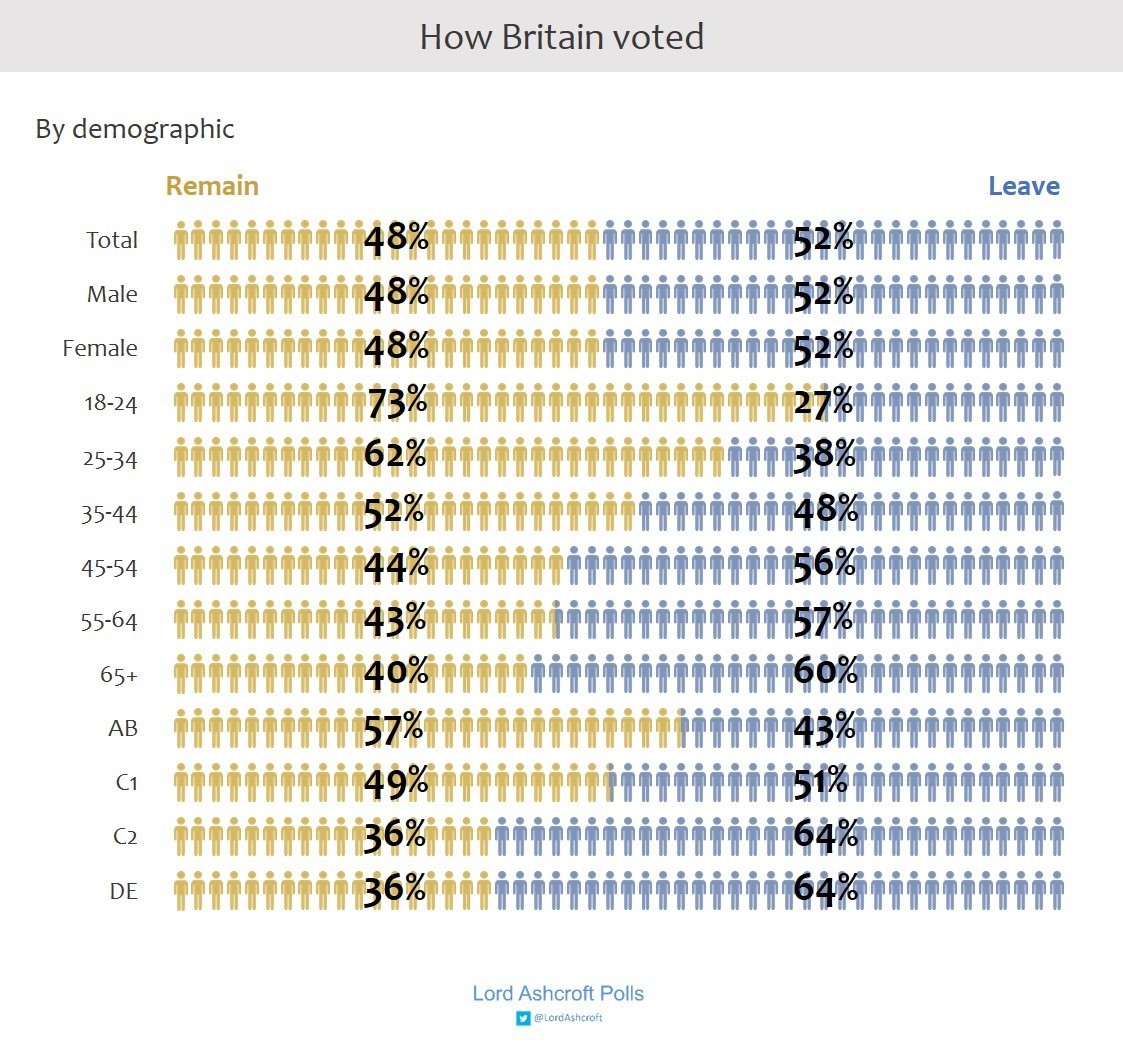
I think the Lord Ashcroft Poll below is important to discuss the current situation. You can see the lower social classes voted leave according to the Lord Ashcroft Poll.
Image result for working class brexit poll

Saturday, 18 August 2018

Thoughts about Immigration and Brexit for a Lexit perspective.

Many people in the United Kingdom on the remain side worry about the abolition of freedom of movement after the EU referendum. Before I start anything, I will make some points from my Marxist perspective. Firstly, national borders are regressive barrier constructed by the idea of a nation, that enforces an idea of separateness. Secondly, I believe it’s a fundamental part of human nature to travel and migrate across the globe throughout Human history. I also believe that the idea of a nation state is a regressive construct, but in our society, as of today, it is a necessary evil. However, there were several issues that I had migration in modern Britain such as the importation of low paid workers into Britain. There is also the concern about our green belt sites that are rapidly being built on to respond to our rapidly growing population. The population of the United Kingdom has approximately increased by 8.5 million in the last 20 years. The population increase is dis-proportionally in England. However, this is not my main point as while this can be problematic we can mitigate against all of the negative effects of this. There is also the fact on a whole immigration has a positive effect on the treasury. I think a fair point is that Immigration benefits the population and mass immigration potentially brings problems to a said nation-state especially where there is a systematic lack of investment as we have today. From my own experience of what I see in society Multiculturalism, on the whole, is a positive thing, though it can potentially cause problems in certain communities when there is a lack of integration into great society. I also see a neglection of British traditions and history, how many people know about the importance of the glorious revolution in constructing our democracy. The main question regarding immigration during the EU referendum was largely on the principle of controlling our borders? Of course, there was unsavoury rhetoric as well.
             
I do support the idea that if we have a democracy and a nation-state we should have a choice to have our own policy of immigration and our borders. Of course, there is a major issue with the idea on the question of Europe, net migration is higher with no EU migration and we do have a clause in which we can deport EU migrant that fail to find any work after 3 months. We do choose to fail to use that clause and we do fail to cut non-EU migration despite the no tolerance policy. Even the current Home Secretary Nosferatu (Sajid Javid) calls her tenure as a hostile environment. This policy led to the Windrush scandal where individuals that should be British citizens were deported to their home countries even if they spent all of their lives in the United Kingdom. I do think there is a split in the Conservative Party between those who want to cut immigration based on their own nationalistic justifications and those who see mass immigration as good for business. The first is generally Brexiters the latter are generally being remainers. Which explains the confusion on the Conservative Policy on immigration, as we did see a record high Net Migration in 2016 of over 300,000 despite the rhetoric. The key question of immigration should we ask, does the public care about immigration? I suspect the majority of the population does not, I think the whole affair has been overplayed by our regressive media, which made the subject relevant. The majority who are concerned with Immigration I believe see a problem with the numbers instead of the racial profiles of those who are immigrating into the country. There was also the concern attached regarding the lack of school places, hospital beds, affordable housing, a lack of decent jobs being attributed to immigration. A lot of people dismiss these arguments, but it is simple if we have a larger population, but we do not prove the infrastructure accommodate immigration will cause legitimate problems.
     
 Many individuals address concerns about a lack of jobs or the lack of quality of jobs due to immigration, while we have little intervention in the market this phenomenon is very possible. If people cannot gain the jobs that their desire or required. The political establishment should have turned its head and listen to their concerns, of course, the Neo-Liberal politicians did not. This is partly why many deprived parts of the country voted to leave the EU. The other side of the debate on this subject there is the idea that employers would struggle to recruit in occupations such as fruit picking. There is a strong capitalist argument for this that the left could perhaps embrace while we still have a capitalist economic system. If there are fewer workers competing for the same jobs than employers, in theory, would have more of incentive to do more to attract more workers in methods such as increasing wages. Wages in this country have been very much stagnant in the last 8 years. I would prefer to live in a society with full employment where employers compete for employees and not the other way round. We should not export workers from abroad that cause labour issues in their own countries. There is also the issue of skilled workers to discuss, the issue of nurses and other skilled workers leaving the country have been a problem, hence we as a nation currently need to do more to encourage them to come and work in this country, this certainly needs to be done in terms of wages. Nurses despite their great hard work have been subjected by the reactionary public sector pay gap. There is also the issue that we are not training enough Nurses and medical Doctors for that matter. Abolishing NHS nursing bursaries in 2017 also led to a drastic reduction in the number of individuals who are training to be Nurses. We must focus on training our own professionals first before accepting those from aboard as we do deprive other countries of these vital skills. especially from third world nations.

To finish my series of essays about immigration I will discuss basic ideas of what we should do on immigration. Borders and immigration are necessary evils to combat the disabling forces that affect open borders (I do not think we truly have that in the EU or in the Schengen Area) and to control the market forces that wish to exploit cheap immigrant Labour. While we have the nation-state, Immigration should be moulded and be fluid to meet the nations need. For example, we currently need to encourage skilled migration to migrate to this country as opposed to low skilled Labour. Our Immigration policy must always be humanist and empathetic especially towards refugees fleeing conflict in Africa and the Middle East. We certainly do need to learn from our mistakes especially after the awful and perhaps racist Windrush scandal of 2018 that led to the resignation of Amber Rudd though her predecessors and the current Prime Minister Theresa May is more to blame for the issue people are not criminals for just migrating to this country. We should have a reformed based system similar to what we saw the Commonwealth countries in terms of Immigration policy outside the European Union. Due to our proximity to Europe, I suggest a basic travel visa and a basic work visa that an individual could easily apply for that would be a visa for the European Union giving similar benefits to the freedom of movement and a long-term visa for visits for longer than 3 months.  This could only occur if we have a meaningful hard Brexit deal which is unlikely now. The current proposal is a £6 visa between the EU and the UK, but I think that is for tourism and no other uses. A separate arrangement is required for Northern Ireland, Gibraltar, Akrotiri and Dhekelia. Sorting the Northern Ireland question would be the most difficult arrangement, but I cannot see a deal that will not have any Irish sea border controls. I know they are vague proposals, but I see it as a bit of a compromise.